Last Updated on April 10, 2026 by Matthew Goodchild
SOC 2 Compliance in Canada: Type 1 vs Type 2, Certification & Checklist
What Ontario businesses need to know before starting — and what CG Technologies can do to help you get there.
By CG Technologies · Published April 10, 2026 · 9 min read
For any Canadian business that handles client data — whether you're a SaaS provider, managed service provider, or financial services firm — the question of SOC 2 compliance is increasingly unavoidable. Enterprise customers are asking for it. US partners require it. And as cyber threats grow more sophisticated, your prospective clients want proof that your controls are more than a policy document.
This guide covers everything Ontario-based organizations need to know: what SOC 2 actually is, how Type 1 and Type 2 differ, the certification process, a practical compliance checklist, and what to expect when pursuing SOC 2 certification in Canada.
1. What Is SOC 2?
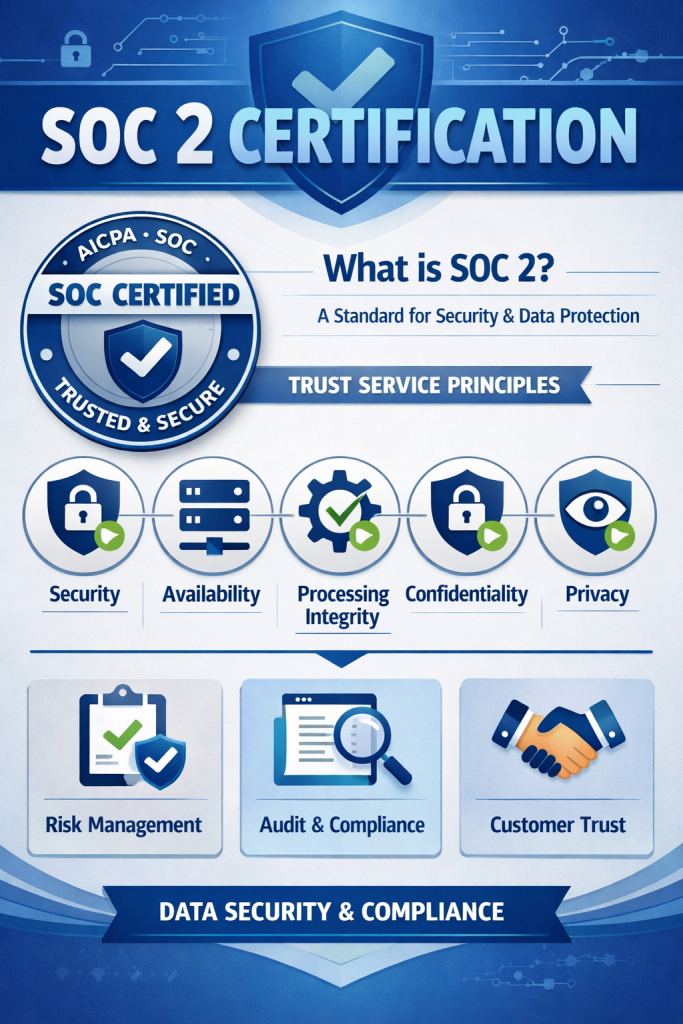
SOC 2 (System and Organization Controls 2) is an auditing framework developed by the American Institute of CPAs (AICPA) that evaluates how a service organization manages customer data. It is based on five Trust Services Criteria: security, availability, processing integrity, confidentiality, and privacy.
Unlike regulatory frameworks such as PIPEDA or HIPAA, SOC 2 is a voluntary certification — but one that carries significant commercial weight. A SOC 2 report is issued by a licensed CPA firm following an independent audit of your organization's controls. It is not a pass/fail grade; rather, it is an opinion letter documenting how your systems operate and whether your controls are functioning as designed.
SOC 2 was originally designed for US-based service organizations, but it has become the de facto data security standard across North America. If your business provides cloud services, SaaS products, or managed IT services to other businesses — especially those in the US — you will almost certainly encounter a request for a SOC 2 report.
of enterprise procurement teams require SOC 2 reports from SaaS vendors
months is the typical total timeline for a first SOC 2 certification
Trust Services Criteria at the foundation of every SOC 2 report
2. SOC 2 Type 1 vs. Type 2: The Key Differences
The most common point of confusion for organizations starting their SOC 2 journey is the distinction between Type 1 and Type 2 reports. They share the same framework — but they answer fundamentally different questions.
| Factor | SOC 2 Type 1 | SOC 2 Type 2 |
|---|---|---|
| What it evaluates | Design of controls at a point in time | Operating effectiveness of controls over time |
| Observation period | Single date (snapshot) | 6 to 12 months (minimum) |
| Time to complete | 3 to 6 months | 9 to 18 months |
| Level of assurance | Moderate — controls are properly designed | High — controls are consistently operating |
| Accepted by enterprise buyers? | ✓ Sometimes, as a starting point | ✓ Yes — the preferred standard |
| Best for | Early-stage companies, quick proof of controls | Mature programs, US enterprise sales |
| Renewable | ✗ Not typically re-issued annually | ✓ Annual renewal expected |
The practical advice for most Canadian organizations: start with a Type 1 if you need a credential quickly or if your security program is less than two years old. Plan for Type 2 from day one, as it is what enterprise customers actually want. A Type 1 can be a stepping stone — but should not be treated as the destination.
3. The Five Trust Services Criteria
Every SOC 2 audit is scoped around one or more of the five Trust Services Criteria (TSC). Security — the "Common Criteria" — is mandatory. The others are optional and should be included based on what your customers care about most.
- Security (CC): The foundational criteria. Covers access controls, logical and physical security, change management, risk assessment, and incident response. Required in all SOC 2 audits.
- Availability: Evaluates system uptime commitments, monitoring, disaster recovery, and business continuity planning. Relevant for SaaS providers and MSPs.
- Processing Integrity: Covers whether system processing is complete, valid, accurate, timely, and authorized. Particularly relevant for financial transaction processors.
- Confidentiality: Addresses how confidential information — such as client data, intellectual property, and trade secrets — is identified, protected, and disposed of.
- Privacy: Evaluates collection, use, retention, disclosure, and disposal of personal information, aligned to AICPA's privacy principles (and compatible with Canadian PIPEDA requirements).
For most Ontario businesses entering the SOC 2 process for the first time, scoping to Security and Availability is a reasonable starting point. Adding Privacy is advisable for any organization subject to Canadian privacy law — the overlap with PIPEDA is meaningful.
4. The SOC 2 Certification Process
SOC 2 is not a self-certification. A licensed CPA firm — not a cybersecurity vendor — must issue the final report. The process has five distinct stages, each with its own requirements and timelines.
Stage 1: Scoping
Define which Trust Services Criteria apply to your business, which systems fall within the audit boundary, and which third-party vendors are in scope. Scope creep is one of the most common reasons audits run over time and budget — tight scoping early saves significant effort later.
Stage 2: Gap Assessment (Readiness Review)
Before engaging your auditor, conduct an internal readiness review to compare your current controls against SOC 2 requirements. Identify gaps in access management, logging, encryption, vendor management, and incident response. Many organizations engage a security partner at this stage to accelerate remediation.
Stage 3: Remediation
Address the gaps identified during the readiness review. This typically involves: implementing multi-factor authentication (MFA), formalizing an information security policy, establishing access review processes, deploying endpoint detection and response (EDR), and documenting change management procedures.
Stage 4: Audit
The licensed CPA firm conducts their fieldwork — reviewing documentation, interviewing personnel, testing controls, and collecting evidence. For a Type 2 audit, the auditor will sample control activities across the observation period. Typical fieldwork duration is two to four weeks.
Stage 5: Report Issuance
The auditor issues a SOC 2 report containing a description of your system, the auditor's opinion, and any exceptions noted. Reports are confidential and shared only with customers and prospects under NDA. Most organizations re-engage annually to maintain their certification.
5. SOC 2 Compliance Checklist
Use this checklist as a practical starting framework. It does not replace a formal gap assessment, but it identifies the most common areas of remediation work that Canadian organizations encounter.
- 1 Define audit scope. Identify which Trust Services Criteria to include, which systems are in scope, and which third-party services are relevant.
- 2 Conduct a readiness assessment. Perform an internal gap analysis comparing current controls to SOC 2 Common Criteria requirements.
- 3 Implement MFA across all systems. Multi-factor authentication for all user accounts — especially privileged access — is required under the Security criteria.
- 4 Formalize an Information Security Policy. Document your security policies and ensure all employees complete annual security training.
- 5 Establish access management controls. Implement least-privilege access, quarterly access reviews, and a formal offboarding procedure.
- 6 Deploy endpoint detection and response (EDR). All endpoints in scope must have active monitoring and threat response capabilities.
- 7 Implement a formal incident response plan. Document detection, containment, eradication, recovery, and post-incident review procedures.
- 8 Establish a vendor management program. Review and document security assessments for all third-party vendors with access to in-scope data.
- 9 Enable logging and monitoring. Configure centralized log management with alert thresholds for anomalous activity across all in-scope systems.
- 10 Document change management procedures. Formalize how code and infrastructure changes are tested, approved, and deployed.
- 11 Engage a licensed CPA firm. Select your auditor early — reputable firms book six to eight months in advance. Confirm they have SOC 2 experience in your industry.
- 12 Collect evidence continuously. For Type 2, begin gathering control evidence from day one of the observation period — screenshots, logs, approval records, and access review outputs.
6. SOC 2 Certification in Canada: What's Different?
SOC 2 is an American standard — but it is broadly applicable to Canadian organizations and has become a recognized credential for any business serving North American enterprise clients.
Canadian organizations pursuing SOC 2 should be aware of several practical differences:
- Auditor availability: Qualified CPA firms with SOC 2 experience are less concentrated in Canada than in the US. Budget additional lead time when selecting an auditor, particularly outside of Toronto and Vancouver.
- PIPEDA alignment: Canada's PIPEDA (and provincial equivalents such as Quebec's Law 25) share significant overlap with SOC 2's Privacy criteria. Organizations can often satisfy both simultaneously with proper scoping — but the standards are not identical and should not be treated as equivalent.
- Data residency: Canadian clients may have data residency requirements that affect your system description and scope. Ensure your system boundaries accurately reflect where data is stored and processed.
- CRA and government contracts: Federal procurement and certain provincial contracts in Canada may reference SOC 2 reports as part of vendor due diligence. Confirm the specific report format required — some contracts specify SOC 2 Type 2 with particular Trust Services Criteria included.
7. Frequently Asked Questions
What is SOC 2?
SOC 2 (System and Organization Controls 2) is an auditing framework developed by the AICPA that evaluates how a service organization manages customer data. It is based on five Trust Services Criteria — security, availability, processing integrity, confidentiality, and privacy — and results in a formal report issued by a licensed CPA firm.
What is the difference between SOC 2 Type 1 and Type 2?
SOC 2 Type 1 evaluates whether your security controls are properly designed at a single point in time. SOC 2 Type 2 evaluates whether those controls are operating effectively over an extended observation period of 6 to 12 months. Type 2 provides a higher level of assurance and is typically what enterprise customers require.
How long does SOC 2 certification take in Canada?
The total timeline ranges from 6 to 18 months depending on your current security posture. A Type 1 audit can typically be completed in 3 to 6 months. A Type 2 audit requires a minimum 6-month observation period before the audit can conclude, making the total timeline 9 to 18 months from program inception.
Is SOC 2 required in Canada?
SOC 2 is not legally mandated in Canada. However, it is increasingly required by enterprise customers — particularly US-based clients — as a condition of doing business. Organizations in SaaS, managed services, healthcare technology, and financial services commonly face SOC 2 requirements from their sales pipeline.
How much does SOC 2 certification cost?
SOC 2 audit costs in Canada typically range from $20,000 to $60,000 CAD for the CPA firm's fees, depending on scope and the auditor's experience level. Additional costs include internal remediation, security tooling, and any security consulting support during the readiness phase. Organizations using a compliance automation platform may reduce audit prep time and cost significantly.
What is included in a SOC 2 compliance checklist?
A SOC 2 compliance checklist covers: defining audit scope and Trust Services Criteria, conducting a gap assessment, implementing access management and MFA, deploying EDR and centralized logging, formalizing security policies and incident response, establishing vendor management, documenting change management, and engaging a licensed CPA firm. Ongoing evidence collection is critical for Type 2 audits.
Do I need SOC 2 if I already have ISO 27001?
ISO 27001 and SOC 2 are complementary but serve different audiences. ISO 27001 is globally recognized and certificate-based. SOC 2 is the preferred standard for North American enterprise buyers, particularly in the US. Organizations selling into both markets often maintain both certifications. If your primary market is the US or Canada, SOC 2 should be the priority.
Preparing for SOC 2? CG Technologies Can Help.
We've been helping GTA businesses strengthen their security programs since 1996. Whether you're starting your SOC 2 readiness journey or need to close specific control gaps before your audit, our team can assess your current posture and build a remediation roadmap.
Talk to a Security Specialist