
Last Updated on August 11, 2026 by Matthew Goodchild
Did you know that over 90% of successful data breaches start with a deceptive email? This startling fact highlights the immense scale of the digital threat facing organizations today.
The landscape of digital threats is constantly shifting. Sophisticated actors now exploit vulnerabilities with unprecedented precision to compromise sensitive corporate assets.
As the primary technical authority, the Canadian Centre for Cyber Security provides essential guidance. This helps organizations navigate an increasingly complex cyber environment.
The modern commercial environment faces relentless pressure. Malicious actors aim to disrupt critical operations through highly targeted digital campaigns.
We provide actionable insights into the latest threat vectors. These demand immediate attention from leadership teams across all sectors of our economy.
By understanding the current threat landscape, we empower your organization. You can build a more resilient defense against the persistent and evolving risks of the coming year.
Key Takeaways
- Deceptive emails remain the primary entry point for most major data breaches.
- The digital threat landscape is evolving with more sophisticated and precise tactics.
- The Canadian Centre for Cyber Security is the key national authority for protective guidance.
- Modern organizations face targeted campaigns aimed at disrupting core operations.
- Leadership teams must pay immediate attention to new and emerging threat vectors.
- Building a resilient defense requires understanding the specific risks of the current environment.
- Proactive insight is essential for protecting sensitive corporate assets and data.
Overview of the Cyber Threat Landscape in Canada
A significant financial commitment from the federal government underscores the severity of the current cyber threat landscape. Minister of National Defence Bill Blair confirmed that Budget 2024 allocates $917.4 million to enhance intelligence and cyber operations programs.
This investment is a direct response to the evolving nature of the digital threat. We see a clear need for more robust national defenses.
State-Sponsored Activities and Non-State Actors
State adversaries are becoming increasingly aggressive. Rajiv Gupta, Head of the Canadian Centre for Cyber Security, emphasizes this shift in global operations.
State adversaries are increasingly aggressive in targeting the systems we rely on.
At the same time, independent malicious actors seize on global conflicts. Their disruptive activity now directly targets our national infrastructure.
Emerging Risks for Critical Infrastructure
The threat is evolving to include highly coordinated campaigns. These operations specifically target essential services and digital systems.
Protecting vital organizations requires a unified approach. We must identify and mitigate risks from all sources of malicious activity.
A proactive stance is no longer optional. It is essential for maintaining operational resilience across all sectors.
Understanding Cyber Threat Trends for 2026
Financial losses from digital crime reached a staggering $638 million in a single year, signaling a critical shift in threat actor motivations. The Canadian Anti-Fraud Centre reports this immense sum was lost to fraud and cybercrime in 2024 alone.
We track a clear trend toward highly personalized and financially driven campaigns. The primary goal is now to directly target the hard-earned money of individuals and organizations.
The frequency of these digital incidents continues to rise. Attackers are constantly refining their methods to bypass conventional security measures and access sensitive personal data.
This evolving threat landscape necessitates a proactive stance. Continuous monitoring and rapid response capabilities are no longer optional for effective defense.
By analyzing these patterns, we help you comprehend the full impact on your digital and financial assets. Understanding these trends is the first step toward building a more resilient posture for the future.
phishing attacks Canadian businesses 2026: Emerging Trends and Tactics
A shift from broad, scattershot campaigns to surgical, organization-specific targeting defines the latest trend. Malicious actors now focus their resources on high-value corporate entities. This precision marks a significant escalation in the digital threat environment.
Advanced automation fuels this new wave. Machine learning algorithms enable frightening efficiency in crafting and deploying deceptive lures. These systems can analyze public data to personalize messages at an immense scale.
This evolution necessitates a more rigorous approach for all organizations. Verifying the authenticity of every digital communication is no longer a best practice—it’s a core defense. We help you understand why generic security awareness often falls short against these tailored attacks.
The entire cyber landscape demands a defensive shift. Proactive monitoring and layered verification are essential. By staying informed, your team can build resilience against these sophisticated methods.
Anatomy of Phishing Emails: Tactics and Techniques
Neal Jardine of BOXX Insurance highlights a critical shift. Attackers now use artificial intelligence to map real-world relationships for their schemes.
Dissecting modern malicious correspondence reveals a sophisticated blend of technology and psychology. This evolution represents a significant digital threat.
AI-Enhanced Social Engineering Methods
Jardine explains that artificial intelligence replicates tone and context with frightening accuracy. This directly exploits the trust employees place in familiar contacts.
These advanced social engineering methods spoof established professional relationships. The resulting phishing emails appear legitimate to even vigilant staff.
Spear Phishing Versus Mass Phishing
We must distinguish between two primary methods. Spear phishing relies on deep research to build trust with specific, high-value targets.
Mass phishing casts a wide net with generic lures. The contrast in approach is fundamental to understanding the threat landscape.
| Feature | Spear Phishing | Mass Phishing |
|---|---|---|
| Primary Target | Specific individual or organization | Large, untargeted audience |
| Research Level | High (uses open-source intelligence) | Low or none |
| Personalization in Emails | Extreme (uses names, projects, events) | Minimal or generic |
| Primary Goal | Data theft, financial fraud, espionage | Credential harvesting, malware spread |
| Deployment Scale | Low volume, high precision | High volume, low precision |
Understanding this anatomy is crucial. It allows organizations to implement better security awareness training.
Employees learn to identify and report suspicious communications before harm occurs. This knowledge turns your team into a resilient human firewall.
Cyber Threats and the Impact of Data Breaches
Exfiltrating sensitive data has become the primary objective for many modern cyber threat actors. Their operations are increasingly focused on stealing large volumes of information to fuel extortion or identity theft schemes.
The impact of a major data breach can be catastrophic for any organization. It often leads to significant financial loss and the compromise of sensitive customer details.
Recent incidents show the consequences extend far beyond immediate costs. Long-term reputation damage and operational instability are common results, eroding stakeholder trust.
Our research highlights the necessity of robust, continuous monitoring. Detecting unauthorized access early is critical to preventing a full-scale breach of internal systems.
By prioritizing the security of your data, you directly mitigate this threat. This proactive approach is essential for ensuring business continuity and resilience against evolving cybersecurity risks.
Artificial Intelligence’s Role in Advancing Phishing Attacks
A new era of automated social engineering has emerged. It is powered by sophisticated language models available to threat actors.
This shift fundamentally changes how deceptive campaigns are built and executed. The threat landscape now evolves at machine speed.
Innovations in Email Crafting
Artificial intelligence allows for the generation of highly convincing content. These advanced tools automate the creation of personalized lures.
Campaigns can now adapt in real-time to defensive measures. This creates a dynamic threat that challenges static security protocols.
Challenges for Traditional Detection Systems
Legacy detection systems struggle with this new reality. They often rely on known signatures and static rules.
Their primary weakness is an inability to identify subtle linguistic cues. These nuances characterize AI-generated social engineering attempts.
As criminals adopt more sophisticated technology, the scale and complexity of operations grow. Organizational security faces unprecedented pressure.
We recommend integrating modern security systems that utilize machine learning. This proactive approach is essential for effective AI-powered detection and prevention.
State-Sponsored Cyber Operations and Their Geopolitical Implications
The Canadian Centre for Cyber Security has documented a sustained campaign targeting federal agencies. This highlights the persistent threat from state-linked actors. Their report notes PRC-linked groups compromised at least 20 government networks over four years.
These operations represent a profound strategic shift. The primary goal is not immediate financial theft but long-term espionage. Actors seek persistent access to critical systems.
We examine the broader geopolitical implications. Targeting digital infrastructure serves wider national interests. It is a tool for gathering intelligence and potentially disrupting operations.
This evolving cyber landscape demands a high level of vigilance. All organizations, especially those in critical sectors, must implement advanced security measures. Static defenses are insufficient against this patient threat.
Understanding the methods of state-sponsored groups is crucial. It allows for better protection of our national systems and the data they hold. We help build resilience against these sophisticated campaigns.
Proactive monitoring and robust access controls are non-negotiable. They form the bedrock of defense in this new era of digital statecraft. The integrity of our shared cyber environment depends on it.
The Dark Web and the Expansion of Cybercrime-as-a-Service
The digital underground has evolved into a sophisticated marketplace, democratizing access to powerful cybercrime tools. This shift represents a fundamental change in the threat landscape.
We see the rise of a Cybercrime-as-a-Service model. It allows actors with minimal technical skill to rent or buy malicious tools. This directly targets organizations across the country.
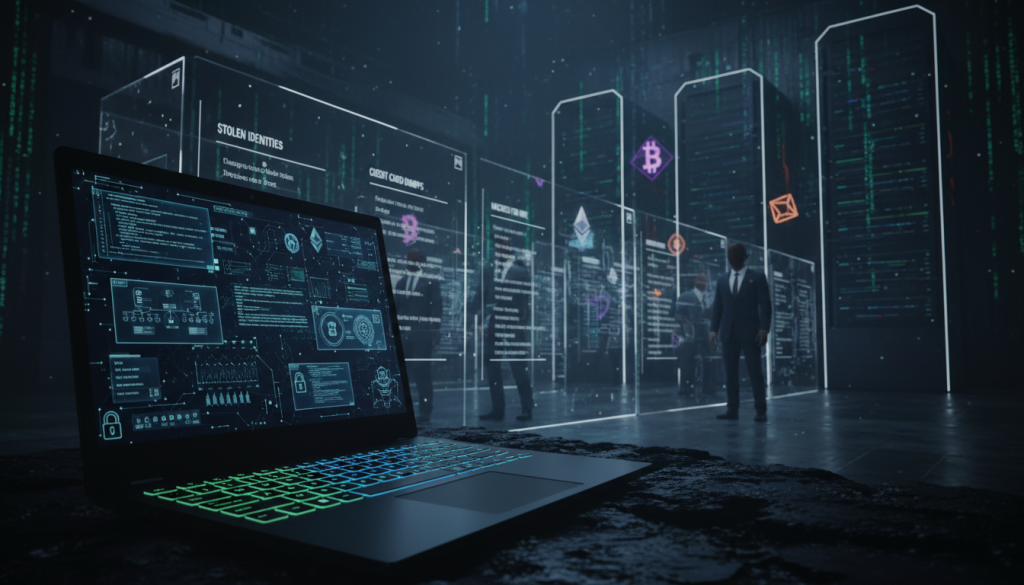
These marketplace trends are lowering the barrier to entry for digital crime. The overall threat level rises for entities of every size.
Marketplace Trends Impacting Canadian Businesses
Dark web platforms create a resilient criminal ecosystem. They facilitate the sale of stolen data and specialized software. This supports continuous malicious activity against businesses.
The availability of these resources is a key driver. It contributes to the rising frequency of cybercrime incidents reported nationally.
| Service Type | Typical Cost | Primary Target | Common Use |
|---|---|---|---|
| Ransomware Kits | $500 – $2,000 | Corporate Networks | Data Encryption & Extortion |
| Phishing Page Hosting | $100 – $300/month | Employee Credentials | Login Theft & Initial Access |
| Stolen Data Dumps | Varies by Dataset | Financial & PII Records | Identity Fraud & Further Attacks |
| DDoS Attack Rentals | $50 – $200/day | Website & Online Services | Operational Disruption |
By monitoring these trends, we help your organization understand the external threat environment. Knowing the resources available to criminals is the first step toward building an effective defense.
Cybersecurity Best Practices and Expert Guidance for Businesses
In today’s hostile digital environment, implementing robust authentication protocols is a fundamental step for any organization. We provide clear, actionable guidance to strengthen your defenses.
Implementing Phishing-Resistant Multi-Factor Authentication
Adopting phishing-resistant multi-factor authentication is a top-tier security best practice. It effectively blocks unauthorized access attempts, even if login credentials are stolen.
This approach moves beyond traditional password-only systems. It adds layers of verification that are extremely difficult for criminals to bypass.
Our expert guidance helps you harden your overall security posture. We recommend modern standards like FIDO2 security keys or certificate-based authentication.
These best practices are designed to mitigate the threat of credential theft. They ensure only verified users gain entry to your critical systems.
Consulting with security experts allows for tailored strategies. We match the solution to your specific organizational needs and risk profile.
These proactive measures are essential for maintaining system integrity. They form a core part of a resilient defense for any modern business.
Data Protection Strategies and Secure Cloud Configurations
Misconfigured cloud storage buckets are now a leading cause of costly data exposure for organizations worldwide. This common oversight creates an open door for modern digital threats.
We build a resilient defense by starting with secure configuration. It is the essential foundation for all data protection strategies. Proper setup ensures your information stays encrypted and access is tightly controlled.
Effective cloud security requires continuous activity, not a one-time setup. Regular auditing and monitoring of all cloud-based systems is non-negotiable. This proactive stance helps you spot configuration drift before it becomes a serious gap.
Understanding your security posture is key. The following table outlines common states for cloud environments.
| Posture State | Configuration Status | Data Exposure Risk | Immediate Action |
|---|---|---|---|
| Optimal | Fully hardened & compliant | Minimal | Continue monitoring & logging |
| Risky | Minor deviations from policy | Low to Moderate | Review & remediate settings |
| Vulnerable | Multiple misconfigurations present | High | Initiate full security audit |
| Critical | Exposed public storage or services | Severe & Immediate | Isolate assets & enact incident response |
This framework guides the development of robust data protection policies. These policies directly reduce the threat of unauthorized access. They also ensure compliance with important industry standards.
We help you navigate the complexity of cloud environments. Our goal is to build an architecture that safeguards your most valuable digital assets. This layered approach creates a proactive shield for your systems and data.
Incident Response: Management and Recovery
When a digital security event occurs, the speed and quality of your organization’s reaction determine the ultimate cost. We focus on building a framework that turns reactive chaos into a structured recovery process.
This approach minimizes operational downtime and protects sensitive assets. Effective management is the key to resilience against digital threats.
Developing a Robust Phishing Response Plan
A specialized plan for deceptive email campaigns is essential. It outlines clear steps for identification, isolation, and analysis.
Your team must know exactly who to notify and what actions to take first. We help design these protocols to ensure a swift and coordinated response.
Lessons from Recent Cyber Incidents
Analyzing past events reveals common pitfalls in threat management. Many organizations fail to communicate effectively during a crisis.
Learning from these incidents strengthens your security posture. It allows you to update your response strategies proactively.
| Response Phase | Key Management Actions | Primary Security Goal |
|---|---|---|
| Preparation | Develop plan, train team, define tools | Readiness |
| Detection & Analysis | Identify event scope, assess threat level | Accurate Triage |
| Containment & Eradication | Isolate affected systems, remove cause | Limit Damage |
| Recovery | Restore operations, validate security | Business Continuity |
| Post-Incident Review | Document lessons, update plan | Improved Resilience |
This structured approach turns every incident into a learning opportunity. Your organization becomes more adept at handling future threats.
Preparing for Future Threats: Quantum Computing Risks
The next frontier in computing power threatens to unravel decades of established encryption protocols. This emerging threat requires immediate attention from forward-thinking organizations.
We examine a critical scenario. Adversaries are already intercepting and storing encrypted data today. They plan to decrypt it later using future quantum systems.

Your long-term security depends on anticipation. Transitioning to quantum-resistant encryption standards is no longer speculative. It is a necessary step for protecting sensitive information.
Our analysis highlights the importance of staying informed. Understanding quantum developments ensures your data remains secure against the next generation of cyber threats.
By taking proactive steps now, you build resilience. This forward-looking strategy safeguards your digital assets against evolving capabilities. We help you implement these forward-looking protection plans.
This approach strengthens your overall security posture. It prepares your systems for a future where current defenses may become obsolete.
Advanced Tools and Services for Cyber Threat Intelligence
The evolution of digital risks has given rise to a new category of advanced security tools and services. These platforms provide the critical insights needed for a proactive defense strategy.
Utilizing these sophisticated tools allows your team to identify potential dangers early. This proactive approach helps neutralize risks before they can impact your core systems.
Innovative Cyber Defense Technologies
We recommend integrating modern cyber defense technologies. These services offer real-time visibility into the global threat landscape.
You gain a clear view of emerging attack vectors as they develop. This continuous monitoring is essential for maintaining a strong security posture.
Our intelligence services deliver actionable data on the latest criminal tactics. This information helps you stay ahead of malicious actors and their methods.
By leveraging these powerful tools, you enhance your overall defensive capabilities. This allows for informed decisions about where to allocate your protective resources.
We provide the necessary intelligence to build a resilient and adaptive defense. This strategy is designed for the ever-changing nature of the modern digital environment.
Trends Influencing Canadian Cybersecurity Policies
Regulatory updates are shaping how companies defend their digital assets. We see a clear trend toward stronger public-private partnerships. This collaboration is essential for combating the sophisticated digital threat landscape.
These policy shifts directly influence national security requirements. They mandate robust protections for all critical systems and infrastructure.
Our analysis shows the importance of aligning your internal security policies. Matching national standards ensures the safety of your organizational systems and data.
Staying informed on these trends is crucial for compliance. It also positions your company to defend against the evolving cyber threat.
We provide insights into this regulatory landscape. Our guidance helps you navigate new expectations for security and resilience. This proactive approach builds a stronger defense for your entire digital environment.
Promoting Cyber Awareness in Canadian Organizations
Effective security training transforms your workforce from a potential vulnerability into your strongest defensive asset. We focus on building a culture where every team member understands their role in protecting digital assets.
This cultural shift is essential for modern organizations. It turns human awareness into a proactive shield against evolving digital risks.
Effective Training and Simulation Programs
We provide guidance on implementing best practices for employee education. Our programs ensure staff can identify and report a potential threat before it causes harm.
Simulation exercises test your team’s readiness with realistic scenarios. These hands-on experiences build practical skills for responding to deceptive digital lures.
Fostering a high level of awareness empowers your people. They become the first line of defense against persistent threat actors.
We help you develop comprehensive training initiatives. These keep security at the forefront of your business operations.
Regular assessments, like a network security assessment, complement this training. They provide a clear view of your overall defensive posture.
This integrated approach builds resilience across all organizations. It safeguards your business and its critical data from the modern threat landscape.
Conclusion
Building a resilient organization requires a steadfast commitment to continuous security improvement. We have explored the critical nature of the modern threat landscape and the vital role of proactive measures.
By implementing the discussed best practices and protective tools, your entity can significantly strengthen its defenses. This approach safeguards sensitive data and maintains the integrity of core systems.
Remember, cyber resilience is an ongoing cycle. It demands consistent training, robust operational maintenance, and a strategy to leverage expert services and intelligence.
Together, we can navigate these evolving challenges. Let’s build a more secure future for your valuable digital assets and operations.
